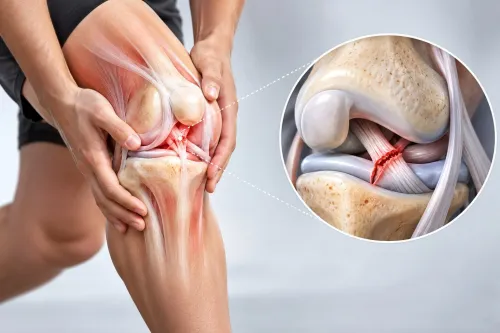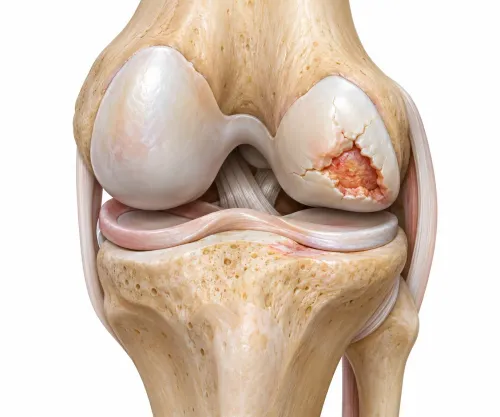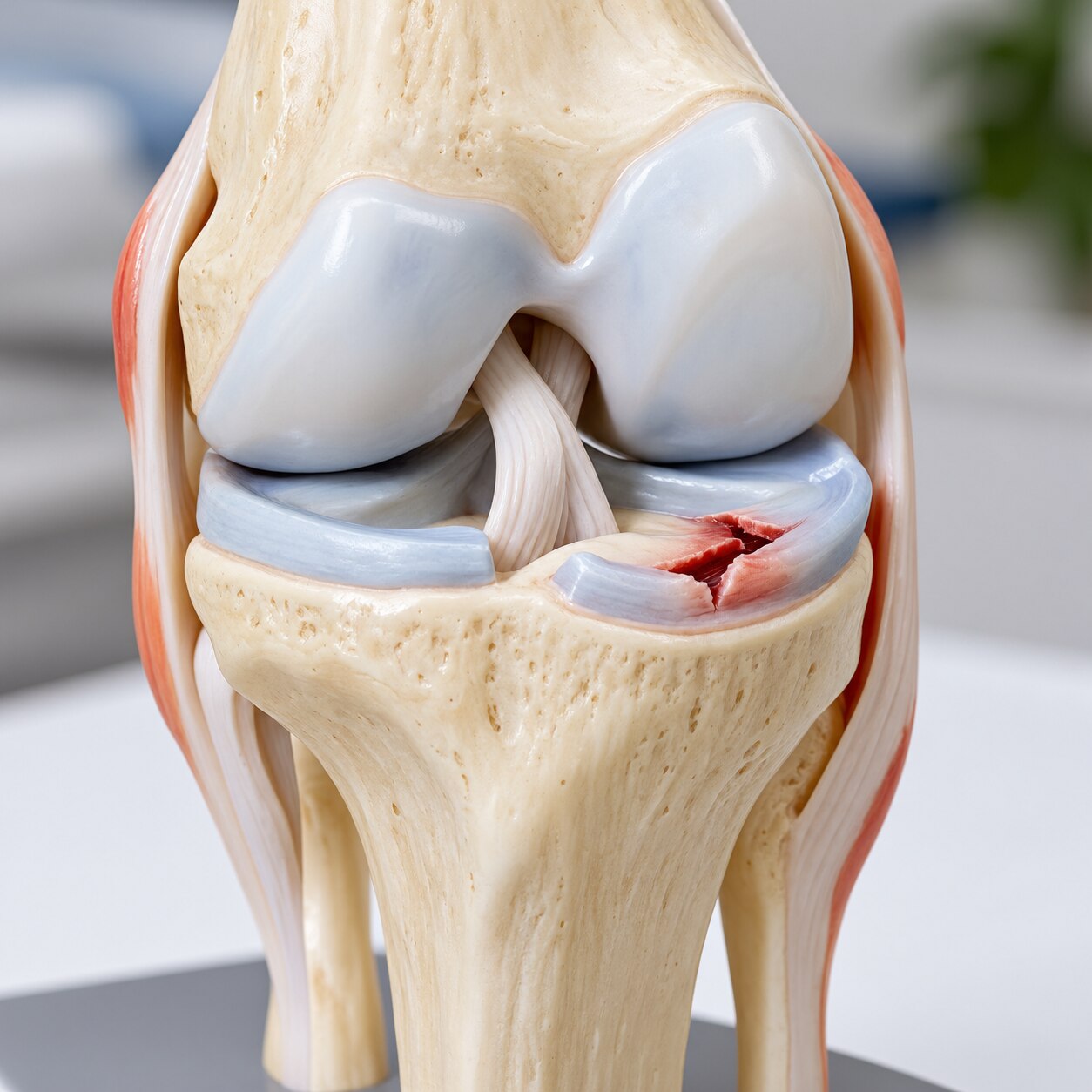
Pain at the inner or outer joint line, swelling after activity, catching and difficulty straightening the knee can follow a meniscus tear, but the same symptoms occur with ligament injuries, arthritis, kneecap problems and fractures. You will learn which signs need urgent assessment, how clinicians confirm the cause and how to weigh physiotherapy, activity changes, injections, repair and partial meniscectomy.
Key takeaways
- Seek urgent care for a locked knee, deformity, fever, or inability to bear weight.
- Use rest, ice, compression, and elevation during the first 24 to 72 hours.
- MRI terms such as tear pattern, location, and displacement guide treatment choices.
- Compare symptom relief, healing potential, rehabilitation time, and surgical risks before deciding.
Which Knee Symptoms Point to a Meniscus Tear—and Which Need Urgent Care?
Pain along the inner or outer joint line, knee pain and swelling after activity, giving-way, and meniscus tear symptoms such as knee catching and clicking point towards a meniscus problem, but none proves it. Many other knee conditions produce the same pattern.
A true locked knee is physically blocked, so you cannot fully straighten or bend it. A displaced bucket-handle tear can cause this blockage and needs prompt orthopaedic assessment. Painful stiffness or intermittent clicking without a fixed obstruction is different and is not a true locked knee.
| Cause | Pattern that may help distinguish it |
|---|---|
| Meniscus tear | Joint-line pain, activity-related swelling, catching or a blocked knee |
| Ligament injury | Giving-way after a twist; rapid swelling raises concern for ACL injury |
| Patellofemoral pain | Pain around the kneecap, worse with stairs, squats or prolonged sitting |
| Osteoarthritis | Gradual pain, stiffness and swelling, often with age-related changes |
| Loose body | Intermittent catching or locking from a fragment inside the joint |
| Fracture | Severe pain, tenderness, inability to bear weight or deformity after trauma |
Seek urgent assessment for an acutely locked knee, inability to bear weight, deformity, or marked swelling soon after injury. Rapid swelling can mean bleeding from an ACL injury, patellar dislocation or osteochondral fracture.
Fever, a red or hot knee, severe pain when someone moves it, or feeling unwell raises concern for septic arthritis rather than a simple meniscus problem. That is a medical emergency.
What Should You Do in the First 24 to 72 Hours, and How Is a Tear Diagnosed?
Stop running, pivoting and twisting the knee. Use relative rest: walk only as much as symptoms allow, and avoid squats, stairs and sport that increase pain.
- Apply a cold pack wrapped in cloth for 10–20 minutes at a time, with breaks between applications.
- Elevate the leg above heart level when resting to help limit swelling.
- Use a walking aid if bearing weight is painful, following professional advice.
- Do not force the knee straight or repeatedly test whether it will lock.
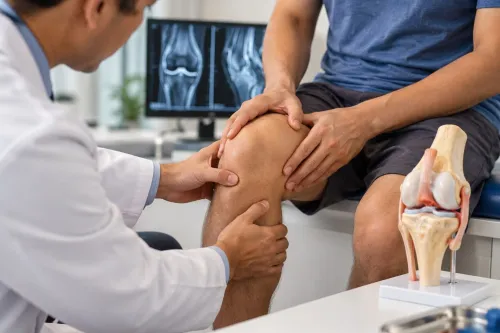
A clinician begins the meniscus tear diagnosis by asking how the injury happened, where you feel pain, when swelling appeared and whether you can bear weight. The examination checks joint-line tenderness, range of motion, ligament stability and signs reproduced by the McMurray test and Thessaly test.
The practical knee X-ray versus MRI distinction is straightforward: an X-ray does not show the meniscus, but it can reveal a fracture, alignment problem or osteoarthritis. Request one after trauma when fracture is suspected or when a validated rule such as the Ottawa Knee Rule indicates imaging.
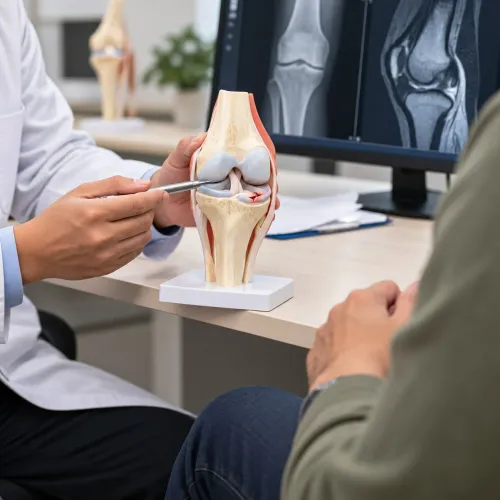
MRI is used when the diagnosis remains uncertain, symptoms persist or surgery is being considered. It visualises the meniscus, ligaments, cartilage and other soft tissues, but an MRI does not replace the examination; an abnormality can exist without causing your pain.
What Does an MRI Tear Description Mean in Practical Terms?
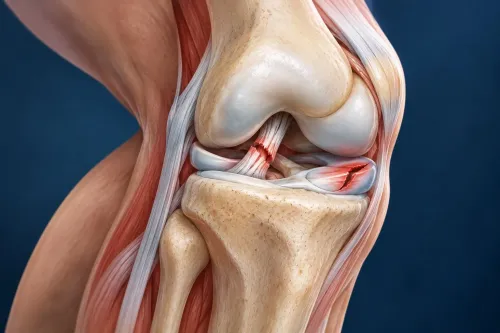
An MRI meniscus tear report describes the tear’s shape and position; it does not decide whether the tear causes your symptoms or which treatment is best.
- A horizontal tear is a split running within the meniscus, often separating its upper and lower surfaces.
- A radial tear cuts across the meniscus fibres, which can interrupt its ability to distribute load.
- A flap tear creates an unstable fragment that can shift during movement.
- A bucket-handle tear is a displaced longitudinal tear; its fragment can block movement and lock the knee.
- A meniscal root tear is a detachment near the meniscus attachment to the bone.
- A degenerative meniscus tear reflects wear-related changes rather than one clear injury.
MRI findings need examination and symptom context because meniscal abnormalities become common with age. Reported rates are 35% in adults aged 50–59 and 67% in adults aged 70–90, and these abnormalities frequently coexist with osteoarthritis.
A younger or active person who twists the knee and develops immediate pain or swelling has a different context from someone with a degenerative meniscus tear and gradual arthritis-related pain. For the latter, quadriceps and hip strengthening, weight management when relevant, and broader arthritis care may help more than treating the scan.
Ask for referral or a second opinion when symptoms, examination and MRI disagree, or when the report identifies a meniscal root tear, persistent locking or associated ligament damage.
Which Meniscus Tear Treatment Fits the Symptoms and the Tear Pattern?
The right meniscus tear treatment options depend on the tear pattern, arthritis, symptoms and goals—not the MRI alone.
| Option | What it can do | What it cannot fix |
|---|---|---|
| Supervised physiotherapy for meniscus tear | Builds quadriceps and hip strength, restores motion and improves load tolerance | Cannot remove a displaced fragment |
| Activity modification and pain relief | Reduces twisting, impact and flare-ups; appropriate analgesia can improve participation | Does not heal every tear or correct a mechanical block |
| Selected injections | May reduce inflammation or pain | Do not restore torn meniscal tissue |
| Arthroscopy | Can address selected displaced fragments or repairable mechanical problems | Is not automatically best for degenerative tears or pain without persistent mechanical symptoms |
A structured conservative programme is common for degenerative tears. Persistent locking, recurrent swelling or failure to improve changes the discussion, but does not prove surgery is required; arthroscopic partial meniscectomy has not outperformed sham surgery for many degenerative symptoms.
If surgery is appropriate, repair preserves shock-absorbing tissue but has a longer meniscus repair recovery, protected movement and a risk of failed healing. Partial meniscectomy recovery is usually faster early on, but removing tissue reduces load distribution and can increase later cartilage stress.
Recovery is staged:
- Early: prescribed range-of-motion work, crutches or a brace when indicated, and swelling control.
- Next: quadriceps and hip strengthening, followed by follow-up appointments to assess movement and loading.
- Later: graduated return to squatting, running and sport, only when strength, motion and symptoms allow.
Pain relief can support rehabilitation, not replace it.
What Should You Ask Before Choosing Surgery or Continuing Conservative Care?
A useful orthopaedic knee consultation should answer questions before meniscus surgery, not simply confirm what an MRI shows. Take this checklist:
- Is the tear repairable, and what features support that decision?
- How much meniscal tissue would partial meniscectomy remove?
- Are the ACL, other ligaments, cartilage or arthritis also damaged?
- Why does the proposed treatment fit my pain, swelling, catching or true locking rather than only the MRI?
- Is a root tear present, and does it change the plan?
| Option | Main benefit | Main trade-off |
|---|---|---|
| Repair | Preserves meniscal tissue | Longer rehabilitation and possible failed repair |
| Partial meniscectomy | Faster early recovery for selected unstable fragments | Less load distribution and greater later cartilage stress |
| Conservative care | Avoids surgical risks while building strength and motion | Cannot remove a displaced fragment causing a fixed blockage |
Ask for a written meniscus rehabilitation plan: physiotherapy sessions, home exercises, crutches or brace use, driving and work restrictions, follow-up dates, and staged return to squatting, running and sport. Clarify total expected costs and meniscus surgery risks, including infection, blood clots, stiffness, nerve or blood-vessel injury, continuing symptoms and later surgery after failed repair.
A second opinion is worthwhile when the knee is not truly locked, or when the examination conflicts with the MRI report. Dr Ronak Kothari can review your injury history, examination and imaging together to judge whether continued rehabilitation, further investigation or surgery is proportionate.
Related services
Knee Arthroscopy & Sports Medicine Knee Arthroscopy & Sports Medicine Dr. Ronak Kothari, a skilled Orthopaedic Surgeon, specializes in Knee Arthroscopy and Sports Medicine, offering advanced, minimally invasive... View service → |
Robotic Joint Replacement Dr. Ronak Kothari, a leading Orthopaedic Surgeon, specializes in Robotic Joint Replacement Surgery, offering state-of-the-art precision and enhanced... View service → |
Frequently asked questions
Which knee symptoms point to a meniscus tear, and which need urgent care?
Joint-line pain, swelling after activity, catching, clicking, and giving-way can indicate a meniscus problem, but they do not prove one. Seek urgent care for a locked knee, visible deformity, fever, severe swelling after an injury, or inability to bear weight.
What should you do during the first 24 to 72 hours after a suspected meniscus injury?
Reduce weight-bearing activity, apply a covered ice pack for short intervals, use compression if it does not worsen pain or numbness, and elevate the leg. Arrange an assessment if symptoms persist, worsen, or restrict movement.
What do MRI terms describing a meniscus tear mean?
The tear pattern, location, size, displacement, and involvement of the vascular outer zone help show whether the tear could heal, explains mechanical symptoms, and affects treatment choices.
Which meniscus tear treatment fits different symptoms and tear patterns?
Mild symptoms without locking may improve with activity changes, pain management, and physiotherapy. Persistent locking, displaced tissue, or symptoms that continue despite rehabilitation may lead to a discussion about arthroscopic repair or selective trimming.
What should you ask before choosing surgery or continuing conservative care?
Ask what confirms the diagnosis, whether the tear is stable or displaced, what non-surgical treatment includes, how long recovery will take, whether repair is possible, and what risks and benefits apply to your knee.